

When choosing a cargo bike, there’s a crucial choice to consider: front load or rear load?
At Bike 43, we’ve opted for a longtail bike. In other words, an elongated two-wheeled bike designed to carry the main load in the rear. But why did we make this choice, rather than a cargo bike with front load transport?
Our bike is part of the continuing evolution of the cargo bike, and to understand its design, we need to go back to the history of cargo bikes. The first cargo bikes appeared in England at the end of the 19th century, when the bicycle was in its early days. Very simple, they were three-wheelers with a load on the front, heavy and without gears. Technical improvements in the bicycle field rapidly improved their efficiency. Businesses adopted them, and cargo bikes became a popular means of transporting goods locally in the early 20th century. Particularly for small traders such as bakers, butchers, milkmen and letter carriers. These bikes were sturdy and could carry a substantial load, but they were still heavy and bulky.

The Danish “Long John” and the Dutch “Bakfiets
During the 20th century, with the development and democratization of the combustion engine, cargo bikes were abandoned in favor of the car. But they began to regain interest in the 1980s, thanks to growing awareness of the climate crisis and urban congestion problems. Cargo bikes are an environmentally-friendly and healthy way to get around town quickly and freely.
It’s in this craze for cargo bikes that some engineers are thinking up new designs adapted to our modern urban environments. As you can read in another article on our blog, Etienne, the founder of Bike 43, was one of these pioneers with the development of our bike. The idea was to make a bike that could transport passengers (or goods) in the easiest way possible, while taking up as little space as possible.

The “Longtail”, a modern bike designed for transporting children in the city
After various trials and developments, the characteristics of longtail bikes can be defined as follows:
- Passengers sit higher on the rear luggage rack. Their safety is greatly enhanced, according to tests carried out by a German automobile association (ADAC). Especially compared with the Long John, where they sit low and up front.
- Shorter and narrower than Long Johns, longtails weave their way through traffic like a conventional bike. They are better suited to narrow city spaces, and park easily in small spaces. They’re also lighter and more portable.
- Having the load at the rear makes the bike more maneuverable and stable, with the weight off the steering. This makes it easy for anyone to carry passengers or goods. These are very accessible bikes, for people of all sizes.
So, how do you choose between a Long John and a Longtail? Let’s make a summary table to see more clearly.
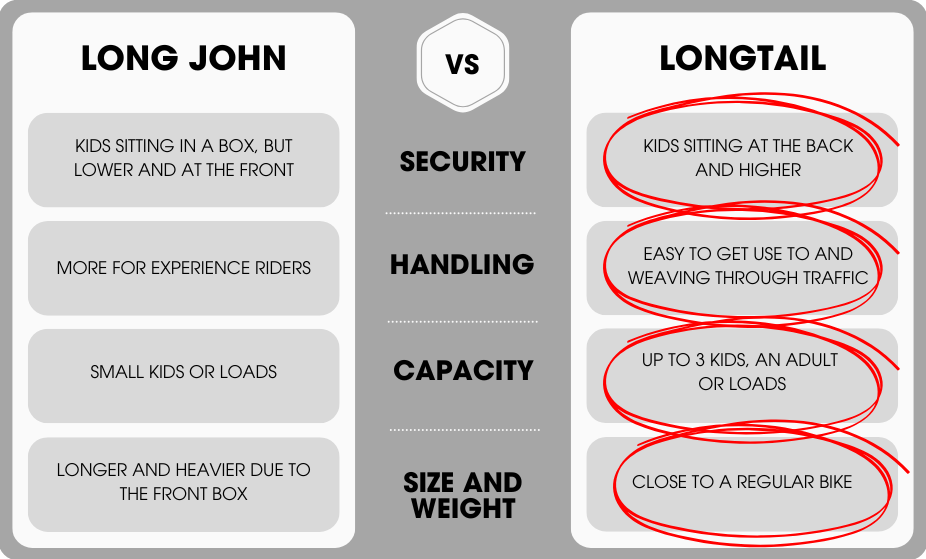
The match is clear! It’s a 4-0 victory for the Longtail over the Long-john, by knockout!
Alright… obviously, we are a longtail brand, so we’re going to defend our type of cargo bike 😉
To be a little more fair-play with our competitors, we can sum it up like this:
A Long John, the historic cargo bike, is more suitable for transporting heavy loads and large equipment. Where a Longtail, the modern cargo bike, is designed for getting easily around town with passengers or goods.
It really depends on you and what you need or prefer- there’s no wrong choice !